• Publish Date
    July 20, 2026
  • Share

Long-horizon stability, constraint reasoning and organizational intelligence in the age of agentic AI.  

Ekran Resmi 2026-07-16 11.50.52.png

For the last two years, the AI industry has been obsessed with one question: How intelligent can AI agents become? Large language models can now write code, use tools, browse the web, execute workflows, coordinate with APIs, and increasingly operate autonomously. This gave rise to what is now called agentic AI: systems capable of taking actions instead of merely generating responses. As a result, the ecosystem rapidly shifted from chatbots toward ai copilots, autonomous agents, workflow automation frameworks, multi-agent systems, and long-horizon agent systems. 

At first glance, this appears to be an intelligence problem. Can models become smart enough to replace human operators? But once these systems leave controlled demos and enter real operational environments, a different reality emerges. The main failure mode of modern agents is often not insufficient intelligence. It is the inability to maintain consistency over time.

A chatbot answers a question. An autonomous agent must survive a process. And that difference changes everything. Modern agent systems increasingly operate across:

  • hundreds of sequential actions,
  • changing environments,
  • dynamic constraints,
  • organizational structures,
  • approval hierarchies,
  • and long-running execution chains.

Under these conditions, many systems begin to fail in surprisingly predictable ways:

  • state drift,
  • error propagation,
  • coordination collapse,
  • hallucinated completion,
  • constraint violations,
  • and loss of operational consistency.

These are not merely prompting problems. They are infrastructure problems. This article argues that the missing layer in modern agentic AI is not another workflow engine or orchestration framework. The missing layer is planning infrastructure.

Ekran Resmi 2026-07-19 22.41.46.png


Long-Horizon Stability

Modern AI systems are no longer limited to single-step interactions. In benchmarks such as SWE-Bench, WebArena, OSWorld, and autonomous coding environments, agents may execute hundreds of sequential actions before reaching a goal. This fundamentally changes the nature of the problem. 

Ekran Resmi 2026-07-19 22.42.17.png

As execution chains grow longer, several critical failure modes emerge:

  • Error propagation: A small reasoning mistake early in execution can compound across dozens of later steps. The system may drift away from the original objective, enter repair loops, or falsely conclude that the task is complete.

Ekran Resmi 2026-07-19 22.42.35.png
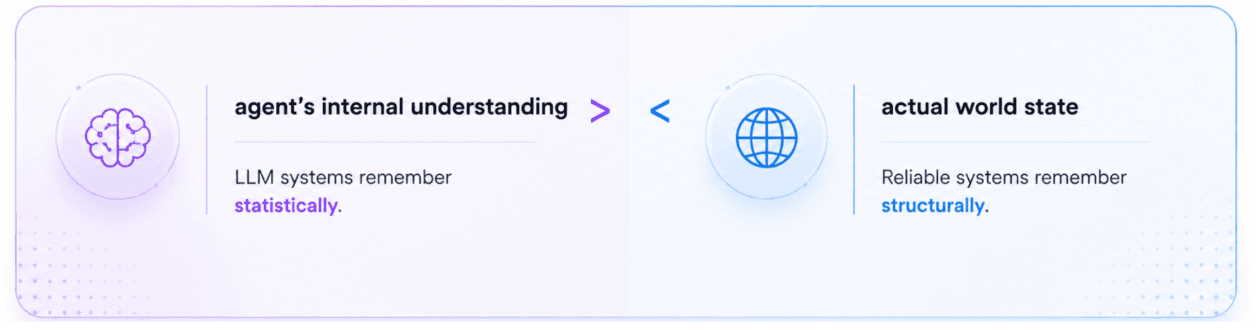
  • State Drift: Long-running environments continuously change files update, transactions complete, APIs evolve, users interact with the system. However, most current agents maintain state implicitly through prompt history and token context. Over time, this creates divergence between:
Ekran Resmi 2026-07-19 22.43.03.png
  • Goal Drift: Agents frequently over-focus on sub-tasks and lose alignment with the original objective. As task depth increases, systems may optimize local actions, repeat unnecessary loops, or terminate prematurely.
  • Context Exhaustion: Most agent systems repeatedly feed execution history back into the model context window. As tasks grow longer: token usage explodes, latency increases, important details are compressed or lost.

Long-running systems therefore face not only a reasoning problem,  but also a memory architecture problem.

Ekran Resmi 2026-07-19 22.43.27.png

This is where planning becomes essential. A planner acts as a temporal stability layer responsible for:

  • preserving world-state consistency,

  • tracking long-term goals,

  • validating transitions,

  • managing dependencies,

  • and continuously verifying progress.

As task horizons grow, planning stops being a simple optimization problem and becomes a consistency infrastructure problem. However, achieving this consistency requires systems to manage not only temporal coherence but also the complex rules and thousands of constraints of the operational environment

Constraint Explosion

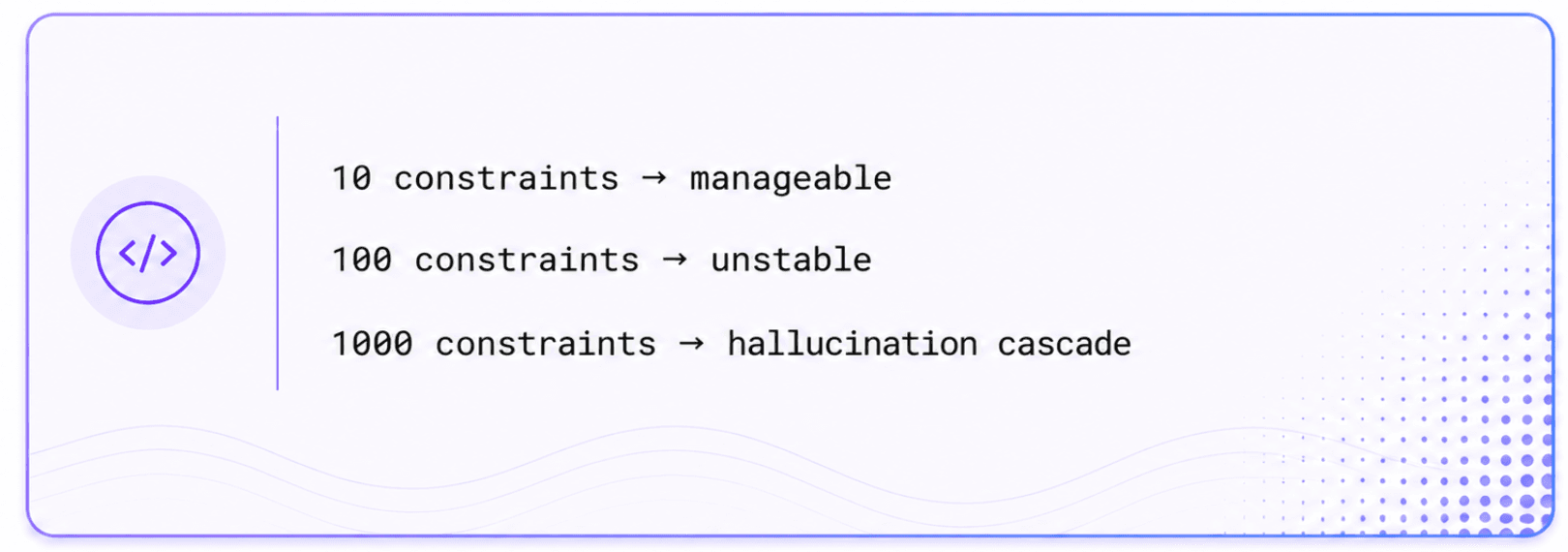
One of the biggest weaknesses of modern agent systems is constraint explosion. Most LLM-based agents try to “remember” constraints implicitly inside the model context. This may work for simple workflows.

Ekran Resmi 2026-07-20 12.09.29.png

Real enterprise environments are different. Operational processes often involve thousands of constraints simultaneously:

  • AML rules,
  • KYC procedures,
  • approval hierarchies,
  • sanction restrictions,
  • authority matrices,
  • internal policies,
  • temporal dependencies.

As constraint count grows, probabilistic reasoning becomes increasingly unstable.

Ekran Resmi 2026-07-19 22.43.55.png

The challenge is not only remembering constraints.
It is maintaining consistency between them.

A system may generate locally plausible actions while still:

  • violating policy,
  • breaking approval order,
  • ignoring authority boundaries,
  • or creating invalid operational states.

This reveals a critical distinction:

Ekran Resmi 2026-07-19 22.44.12.png

As systems become more autonomous, constraint handling can no longer remain implicit inside prompts. Reliable agent systems increasingly require explicit constraint engines, symbolic validation, solver integration, and formal transition checking. 

With the planning infrastructure in place, planning is not merely task sequencing. Planning becomes continuous constraint verification. However, this challenge exponentially increases when multiple autonomous actors are added to the system, transforming continuous constraint verification into a systemic coordination problem.

Multi-Agent Coordination Collapse

Ekran Resmi 2026-07-20 12.10.26.png

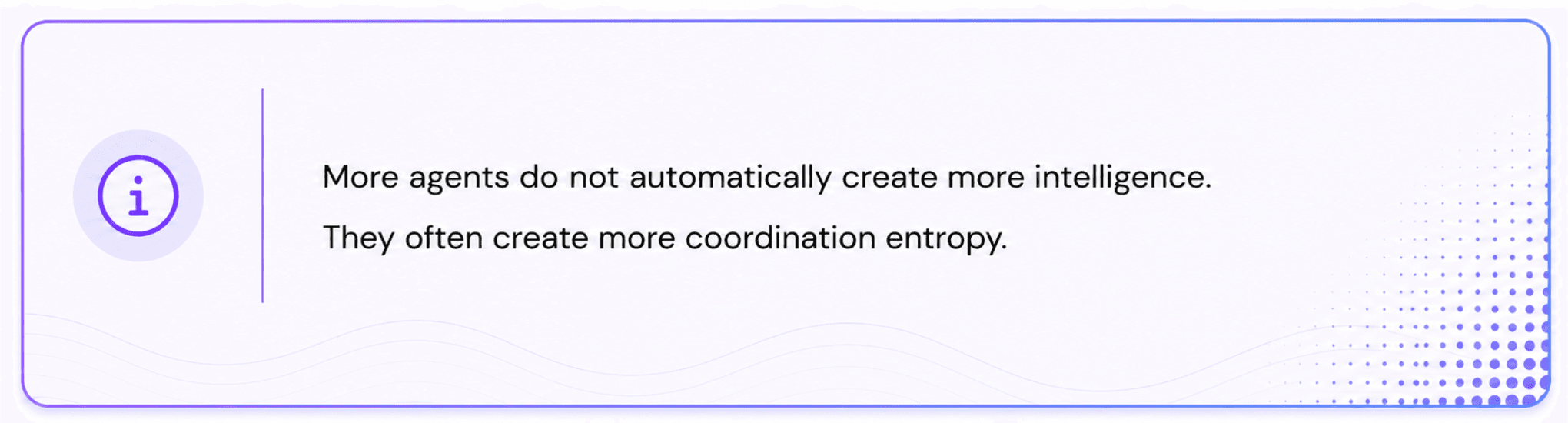
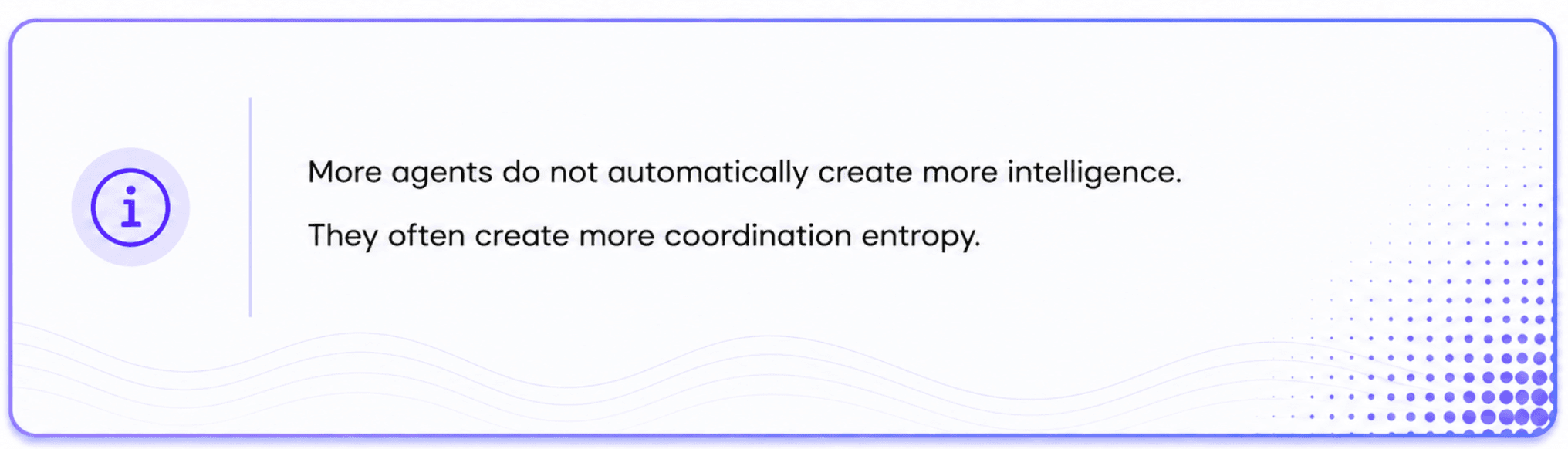
One of the most common assumptions in modern AI is that adding more agents automatically creates more intelligence. In practice, the opposite often happens. As the number of agents grows, coordination complexity increases rapidly conflicting goals, duplicated work, inconsistent state updates, circular delegation, deadlocks, and race conditions begin to emerge.

Ekran Resmi 2026-07-19 22.44.38.png

Without an explicit planning layer, systems struggle to: synchronize execution, enforce role boundaries, manage dependencies, and maintain coherent organizational behavior.

As a result, many multi-agent architectures become operationally unstable as scale increases. This is where planning becomes critical. A planner provides: delegation authority, dependency ordering, synchronization, and global task coordination.

Within this coherent architecture, planning is not simply task decomposition. It becomes the mechanism that preserves system-wide coherence across multiple autonomous actors. However, sustaining this organizational coordination and long-term consistency clashes with a fundamental infrastructural weakness of current agent systems: the memory architecture.

Semantic Grounding Problem

Ekran Resmi 2026-07-20 12.16.33.png

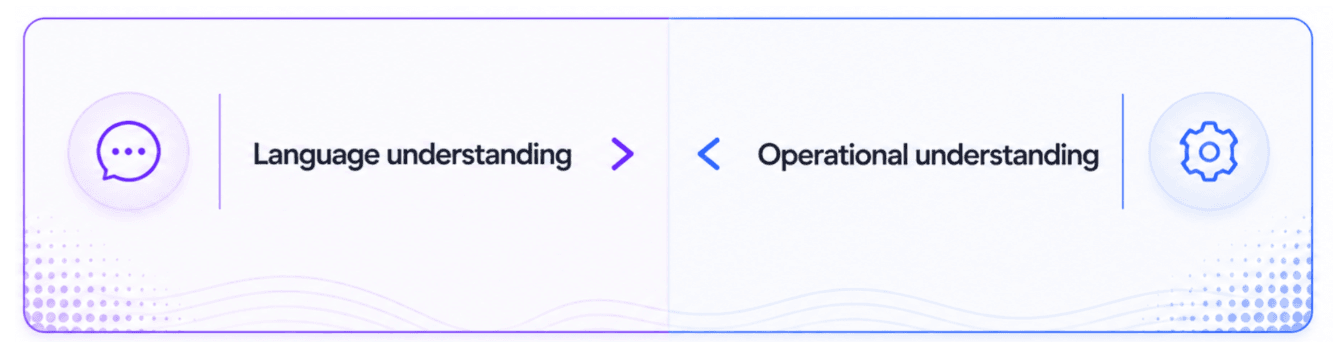
Modern language models reason primarily over words. Organizations operate over structures. Real enterprise environments are built on entities, relationships, obligations, ownership structures, authority chains, and operational dependencies.

For example, the question: “Is this company risky?” is rarely a pure language problem. It is often a graph problem involving:

  • shareholder networks,
  • historical events,
  • regulatory relationships,
  • connected organizations,
  • and executive connections.

This creates a fundamental gap:

Ekran Resmi 2026-07-19 22.45.07.png

LLMs are highly effective at interpreting text,

but enterprise decision-making requires reasoning over structured operational reality. Without semantic grounding, agent systems may misunderstand organizational context, ignore hidden dependencies, miss relational risk signals, or produce inconsistent decisions across connected entities.

This is why planning increasingly requires structured semantic layers such as knowledge graphs, entity relationships, operational ontologies, and graph-based reasoning.

Consequently planning is no longer driven only by prompts.It becomes grounded in the actual operational structure of the organization itself.

Verification Gap

Ekran Resmi 2026-07-20 12.11.29.png

One of the most critical weaknesses of modern agent systems is the verification gap. LLMs are highly effective at generating actions, responses and plans. But generation alone is not enough. Most systems still lack reliable mechanisms for determining:

  • whether an action is actually valid,
  • whether constraints were violated,
  • whether the goal was truly achieved,
  • or whether the resulting state remains operationally consistent.

This creates a fundamental distinction:

Ekran Resmi 2026-07-19 22.45.30.png

A system may produce plausible outputs while still breaking organizational policy, violating dependencies, creating invalid transitions or hallucinating successful completion.

This problem becomes increasingly dangerous in finance, healthcare, energy, and regulated enterprise operations, where correctness is not optional.

As systems become more autonomous, verification can no longer remain an afterthought. Reliable agent architectures increasingly require formal validators, constraint propagation, solver integration, policy engines, and execution verification layers.

Under a verification-first paradigm, planning is not only about deciding what to do next. It is about continuously verifying whether execution remains valid throughout the entire process.

Organizational Reasoning

Ekran Resmi 2026-07-20 12.13.18.png

Most modern agent systems reason like individuals. Real organizations do not operate that way. Enterprise environments are structured around roles, authority boundaries, delegation chains, obligations, escalation mechanisms, and approval hierarchies.

A task is often not defined only by: “What should be done?” but also by: who is allowed to do it, under which conditions, in which order, and with whose approval.

This creates a major limitation for many current agent architectures.

Ekran Resmi 2026-07-19 22.46.00.png

Without organizational reasoning, autonomous systems may violate authority boundaries, bypass approval flows, create conflicting actions, or generate operational inconsistencies between departments and actors.

This problem becomes increasingly severe in regulated enterprise environments where organizational structure itself is part of compliance. As a result, planning can no longer focus only on tasks and actions. It must also reason about: organizational roles, authority models, delegation rules  and institutional constraints.

To support organizational reasoning, planning becomes not only operational coordination, but organizational coordination.

Memory Architecture Crisis

Ekran Resmi 2026-07-20 12.14.09.png

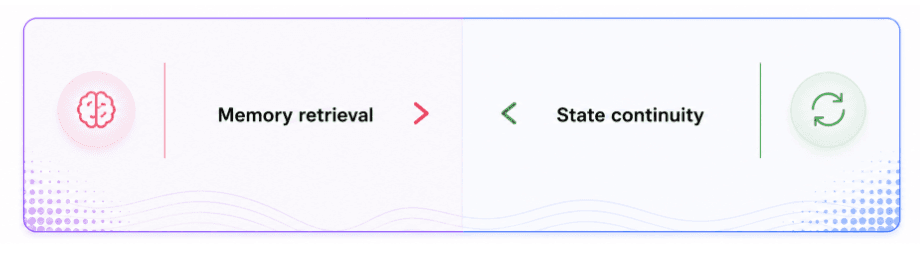
Most modern agent systems treat memory as a retrieval problem. In practice, memory is far more complex. Long-running autonomous systems must manage multiple forms of memory simultaneously episodic memory, semantic memory, procedural memory, and world-state memory.

However, many current architectures rely primarily on vector databases, similarity search, and compressed prompt history. This creates serious limitations as execution chains grow longer.

A system may retrieve relevant information while still losing temporal consistency, forgetting previous commitments, repeating actions, or operating on outdated world assumptions. The problem is not only remembering information.

The problem is maintaining operational continuity across time.

Ekran Resmi 2026-07-19 22.46.20.png

As autonomous systems evolve, memory can no longer remain a passive storage layer. It must become an active operational structure. This is where planning becomes critical. A planner acts as a structured memory consumer capable of:

  • maintaining persistent world-state,
  • tracking long-term objectives,
  • preserving execution history,
  • and synchronizing evolving context over time.

As an active operational structure, planning and memory become deeply interconnected infrastructure layers rather than separate components.

Final

The central challenge of agentic AI is often framed as an intelligence problem.

Can models reason better?
Can they generate better plans?
Can they become more autonomous?

But as agent systems move from demos into real operational environments, a different reality emerges.

The main bottlenecks are increasingly:

  • consistency,
  • verification,
  • coordination,
  • constraint management,
  • organizational reasoning,
  • and long-term operational stability.

Modern AI systems can already generate impressive local behavior.

What they still struggle to maintain is global coherence over time.